2026 releases | The Alchemist's Garden | Private editorial draft
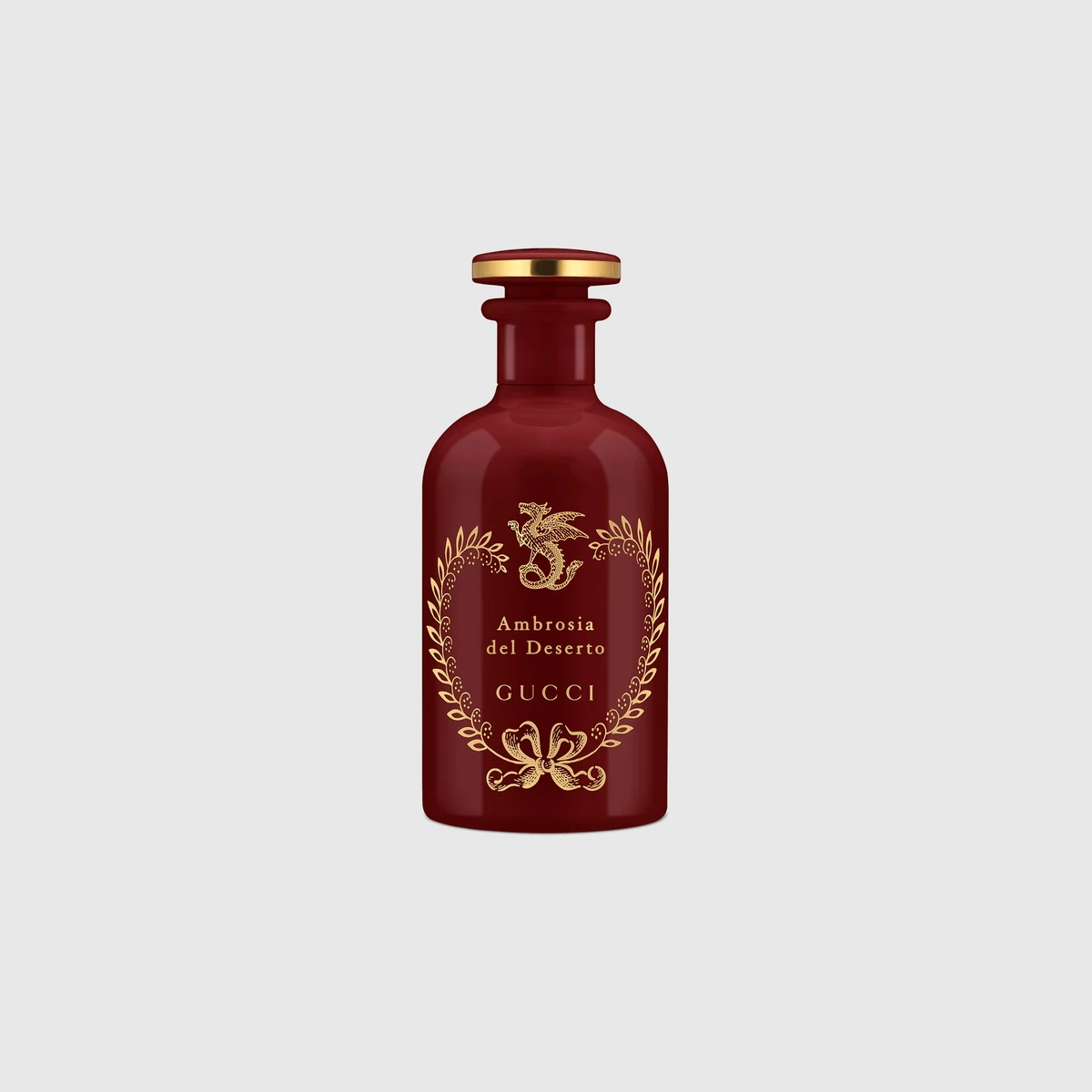
Among the striking bottles in Gucci's The Alchemist's Garden, the red flacon decorated with a golden dragon demands attention. But the real reason to examine Ambrosia del Deserto Eau de Parfum is the unusual conversation between candied dates, rose, blood orange and an earthy patchouli foundation. Launched in 2026, this perfume is described by Gucci as a Fruity Chypre. It has a sweet theme, but the official family label stops short of calling it a straightforward edible gourmand.
This guide asks a few precise questions. Which notes does Gucci actually put in its three-tier pyramid? Why does the manufacturer talk about velvety rose even though the structured heart list names Pamarose rather than a separate rose entry? What role do vanillin and benzoin play in the conceptual base? And when choosing between 50 ml and 100 ml, what matters more than a colorful promotional photograph? The answers below are research-based, not the product of a fictional day-long wear test. Performance and personal taste still need real sampling.
Gucci Ambrosia del Deserto at a glance: This 2026 Eau de Parfum from The Alchemist’s Garden is described as a fruity chypre, with blood orange, a candied-date impression and a warm patchouli, vanillin and benzoin base. Gucci’s poetic description refers to a velvety rose, while its formal heart list explicitly names Pamarose, not Rose Absolute as a standalone material. Distinguishing those sources helps avoid a misleading pyramid.
What is Gucci Ambrosia del Deserto?
The fragrance is a 2026 edition in Gucci's luxury The Alchemist's Garden collection. The line draws on the visual language of historic apothecaries and ideas about transformation. Gucci credits the perfume to Nadège Le Garlantezec, whose name appears with a small spelling variation on some official storefronts. Independent specialist coverage published in September 2026 documented its arrival. Together with the manufacturer product pages, this supports its identity as a new release rather than a repackaged older scent.
Gucci lists the 100 ml Eau de Parfum under style A001U8 99999 0099 and the 50 ml Eau de Parfum under A001WX 99999 0099. These are different package sizes of the same edition. A legitimate product database should not count them as two independent 2026 perfumes. If you are comparing sellers, checking the full name and size can prevent mistakes that arise when shops display a generic photograph of The Alchemist's Garden.
Why call a date-centered fragrance a Fruity Chypre?
Chypre is a broad family whose interpretations often balance a brighter opening and floral or fruit facets against a more grounded base. It is not a chemical checklist that requires every traditional raw material to be present in every modern perfume. Gucci emphasizes candied date sweetness but also highlights blood orange and patchouli. These contrasts explain the classification more usefully than assuming the fragrance must be a thick dessert because it contains a date accord.
A family label cannot disclose the actual sweetness level experienced on skin. The note list creates expectations that still have to be tested. Someone who enjoys earthy-fruity chypres may find the design intriguing, while a person looking for a light, nearly transparent citrus fragrance could find the idea less suitable. Neither group should be promised a precise sensory result based on the page alone.
Official top notes: angelica, apricot, cinnamon and blood orange
| Tier | Declared materials | What the combination implies |
|---|---|---|
| Top | Angelica Seed; Apricot Flash Delight; Cinnamon Bark Oil; Blood Orange Oil | Spiced fruit and citrus |
| Heart | Davana Oil; Immortelle Absolute; Date Delight; Pamarose | Herbal-floral, date-like richness |
| Base | Patchouli Oil Coeur; Vanillin Ex-Rice; Benzoin Resinoid | Sweet resin and earthy depth |
The manufacturer's prose emphasizes a velvety rose impression, but the labeled heart entry is Pamarose; do not relabel it Rose Absolute.
Gucci lists Angelica Seed, Apricot Flash Delight, Cinnamon Bark Oil Laos Orpur and Blood Orange Oil in the opening. Angelica may call to mind an aromatic herbal facet; apricot suggests a soft fruit impression; cinnamon introduces warmth; and blood orange offers a sharper citrus reference. The interplay seems designed to avoid a one-dimensional sugary first impression.
However, a word such as “apricot” in a trademarked accord name is not necessarily proof that a natural apricot extract appears separately in a formula. Nor does “cinnamon bark” tell us how much spice the finished perfume contains. These distinctions matter for readers looking for credible information rather than a fantasy description in which every listed note announces itself loudly at a predetermined moment.
Gucci's marketing foregrounds blood orange as the bright side of the composition. It is reasonable to view that as a counterweight to the candied-date image developed elsewhere, but it would be unreasonable to give the opening an invented tartness score or to claim everyone smells the orange for the same duration. A careful blotter test helps establish whether this element registers prominently for you.
The heart: davana, immortelle, Date Delight and Pamarose
The structured heart tier comprises Davana Oil India Orpur, Immortelle Absolute, Date Delight and Pamarose. Davana is often associated with herbal and fruity directions; immortelle can suggest warmth and unusual savory-sweet impressions in some fragrance contexts. Date Delight puts the product's date theme into its labeled pyramid, while Pamarose is a specific perfumery name and should not be silently replaced with “natural rose absolute.”
Does Gucci list rose as an official heart note?
Gucci absolutely mentions velvety rose in the central product description, where it pairs rose with the sweetness of candied date. Yet the brand's formal heart list names Pamarose without a separate entry titled Rose. Other perfume databases display rose in a fuller pyramid. The most transparent way to write about the edition is to preserve both pieces of evidence: rose is part of the brand's descriptive identity; Pamarose is the term appearing in the labeled heart list.
There is no need to accuse outside editors of fabricating information, because editorial classifications often draw on promotional narratives as well as structured notes. The problem begins only when a compiled third-party pyramid is attributed directly to the brand as an exact transcription. If someone is researching a particular rose material for preference or sensitivity reasons, that distinction can influence how they interpret the product.
What does candied date mean in a perfume?
The manufacturer discusses Candied Date in its prose but lists Date Delight in the heart. One phrase evokes the sweet, preserved fruit; the other names an accord-like aspect of the perfume's architecture. This does not establish that date paste, syrup or a measurable natural date extract is used. Perfumery can create a recognizable food-like impression through combinations of different materials, so a note name should not be treated like the ingredient panel of a dessert.
Readers familiar with dates from everyday life may bring their own smell memories to the testing experience. That makes the idea personally interesting without making this an intrinsically Middle Eastern or Saudi perfume. It is a Gucci product placed within an established Italian luxury collection, with a particular date-and-rose concept. How closely the finished smell evokes actual candied dates remains an open question until sampled.
The base: patchouli, vanillin and benzoin
The official foundation consists of Patchouli Oil Coeur, Vanillin Ex-Rice and Benzoin Resinoid Laos Orpur. Patchouli contributes to the manufacturer's earthy chypre theme. Vanillin can suggest vanilla-like warmth and sweetness, while benzoin is commonly associated with resinous and softly balsamic effects. The exact labels are worth preserving: Vanillin Ex-Rice is not the same term as “natural vanilla pod,” and the presence of benzoin does not automatically make the composition an incense bomb.
These elements offer a plausible structural contrast to the fruit and candied-date references. They cannot tell us whether the perfume ultimately feels dry, heavy, airy or edible on every wearer. Ingredients interact, and the official list does not provide their proportions. A later skin check is essential if you want to know whether the patchouli tempers the sweetness or whether the warm base becomes the defining impression for you.
Is Ambrosia del Deserto a gourmand?
There is clearly a gourmand-adjacent idea in the candied-date description and the vanillin note. But Gucci's own primary family is Fruity Chypre. Calling it a pure gourmand while ignoring citrus, angelica and patchouli would erase half the concept. A more useful description is “a fruity chypre featuring a candied-date effect,” leaving individual reviewers free to report how edible or dry it seems in real life.
The bottle: red glass and a golden dragon
Gucci describes the 2026 release in a red glass flacon with a golden dragon, a gold-toned stopper and a red box. Its shape refers to the antique apothecary containers that inspire The Alchemist's Garden. The house explains the dragon as a symbol of enduring grandeur and a guardian of secrets. This is a visual narrative, not evidence that the perfume includes particular spices or lasts longer than other members of the line.
That visual identity is practical when choosing the exact bottle. Do not rely solely on a red promotional banner that might appear beside several products. Read the name and concentration, confirm the style code where available, and inspect the retailer's terms. A matching promotional image is helpful for edition identification but does not authenticate an individual item sold by an unknown merchant.
Does the 50 ml version smell different?
Not according to the manufacturer's product naming. Both official sizes carry the Ambrosia del Deserto Eau de Parfum identity. They are size variants, not separate fragrance launches. A larger bottle can offer a different cost per milliliter, but the choice should depend on how much perfume you expect to use after trying it, not on a mistaken belief that the 100 ml has richer notes.
How does it fit within The Alchemist's Garden?
The collection includes numerous fragrances using elaborate naming, decorative bottles and narratives of materials undergoing transformation. Ambrosia del Deserto stands out in the current lineup through its red-and-gold dragon identity and its candied-date and fruity-chypre framing. That does not make it equivalent to other releases containing roses, nor does it justify importing their pyramids into this article.
If you already own another Gucci Alchemist's Garden fragrance, compare the exact descriptions and sample the new edition separately. The appeal of the collection can encourage collecting bottles for aesthetic reasons; that is a personal choice, but it differs from the question of whether the liquid offers an olfactory experience you want to wear. Both motivations can be acknowledged without disguising decoration as measurable fragrance performance.
Who might like the scent on paper?
The fragrance is presented across specialist databases as suitable for women and men. Its note list may appeal to someone who enjoys fruit with a richer, earthier backbone, or who is curious about dates in fine fragrance. A wearer sensitive to cinnamon, sweet accords or patchouli might need a particularly cautious sample. Gender labels are less informative than personal preference for these components.
We do not claim it is the perfect office fragrance or an automatic winter favorite. Dose, ventilation, heat and other people's sensitivities matter. Begin with a modest application in shared spaces. If you want to wear it for an evening event, trial it beforehand so that an unexpectedly intense sweet or woody impression does not take you by surprise. Describing a base as warm does not establish an objective seasonal restriction.
Does Gucci promise specific longevity?
The brand uses positive language about the fragrance's persistence, but no note pyramid alone demonstrates a universal number of wear hours. Individual accounts may be useful as subjective reports; they are not interchangeable with an independent standardized trial. This guide does not publish a made-up longevity chart, and it avoids presenting “all day” as something guaranteed for every skin and environment.
Choosing 50 or 100 ml with a real budget
A fragrance in Gucci's luxury line can represent a substantial purchase. The official 50 and 100 ml products have different prices, which vary by country and may change over time. Rather than reproduce a fixed regional price that will soon be outdated, look up the actual offer from a trusted seller, confirm the currency and account for shipping or taxes before comparing. You can use ScentMira's price-per-ml calculator with those figures.
The lowest unit price is not always the best personal value. If you have never smelled the date and patchouli combination, starting with a legitimate sample is often safer than buying the larger bottle. If you know you love the scent and plan to wear it regularly, 100 ml might make financial sense. This is a purchasing decision, not a separate olfactory edition.
Five checks before you buy
First, verify the exact full name and Eau de Parfum concentration. Second, compare the 50 and 100 ml style references and ensure the vendor's image matches the correct product. Third, distinguish the official structured heart from the rose-and-date narrative rather than trusting an unqualified online pyramid. Fourth, sample it under conditions similar to your daily wear, allowing enough time to assess both the opening and base. Finally, consider whether its fruity-chypre concept adds something you genuinely want to your existing collection.
The goal is not to force your nose to identify every trademarked accord. A person can enjoy the perfume without separating Date Delight from davana, and another can dislike it despite loving the published ingredients. Knowing those possibilities is what makes a guide useful: facts help you select what to try, while experience supplies the final judgment.
Verdict: more than a photogenic dragon bottle
Ambrosia del Deserto is a documented 2026 addition to The Alchemist's Garden with official 50 and 100 ml Eau de Parfum presentations. Its creative proposition combines blood orange, candied date, rose and earthy patchouli within a fruity-chypre family, supported by a more detailed pyramid of angelica, apricot, cinnamon, davana, immortelle, Pamarose, vanillin and benzoin. The exact distinction between rose in the house's prose and Pamarose in the heart list is central to reading the official evidence accurately.
It deserves a place on a sampling shortlist for people intrigued by rich fruity effects grounded in chypre structure. It should not be purchased blindly merely because the red bottle looks collectible, nor rejected solely because dates sound too sweet. Verify the edition, test the perfume and choose an appropriate size after you understand your own reaction.
Frequently asked questions
Was Gucci Ambrosia del Deserto launched in 2026?
Yes. It is listed as a 2026 release, with contemporary coverage of its September availability.
What concentration does it use?
Gucci calls it Eau de Parfum in both its 50 ml and 100 ml official product pages.
Who is the perfumer?
Nadège Le Garlantezec, whose name is spelled slightly differently in some official storefront copy.
Is rose an official ingredient?
Gucci describes velvety rose in its marketing text, while its structured heart tier names Pamarose rather than a separate Rose entry.
What are its key scent themes?
Blood orange, candied date, rose and patchouli are the major notes emphasized in the brand's introductory description.
Is it a men's or women's perfume?
Specialist fragrance resources present it for women and men, while actual preference is individual.
Which sizes does Gucci offer?
50 ml and 100 ml Eau de Parfum are documented on the official website.
Does it have guaranteed all-day longevity?
The marketing and note information cannot establish a universal number of hours for every wearer; personal testing is needed.