Every fragrance collection eventually faces a question: how do you introduce another edition without losing the character people already love? Gucci Bloom Ambrosia d’Oro Eau de Parfum, introduced in 2026, answers by keeping the recognizable white-floral setting of Bloom while foregrounding a Golden Queen accord with an apricot-like impression and adding detailed musky and woody elements. This is a new perfume, not a newly labeled 100 ml bottle of the original Bloom.
The interesting part is not whether the latest product is automatically better. It is how the product differs in its stated composition, how Gucci describes the proprietary accords, and what someone who already owns Bloom should compare before spending money. This guide draws on Gucci's published product details and dated release coverage. It does not pretend that a product-page pyramid proves a specific number of wear hours, or that a reader can know precisely how a scent performs without wearing it.
What makes 2026 Gucci Bloom Ambrosia d’Oro different? It is a distinct Eau de Parfum within the Bloom range, not a repackaging of the 2017 original. Gucci names ginger, Ambrox S Super and Golden Globe NaturePrint in its opening, multiple tuberose and jasmine materials at its heart, and patchouli, sandalwood and cypriol in the base. An apricot-like impression tied to the golden-fruit accord must not be presented as proof of a natural apricot extract.
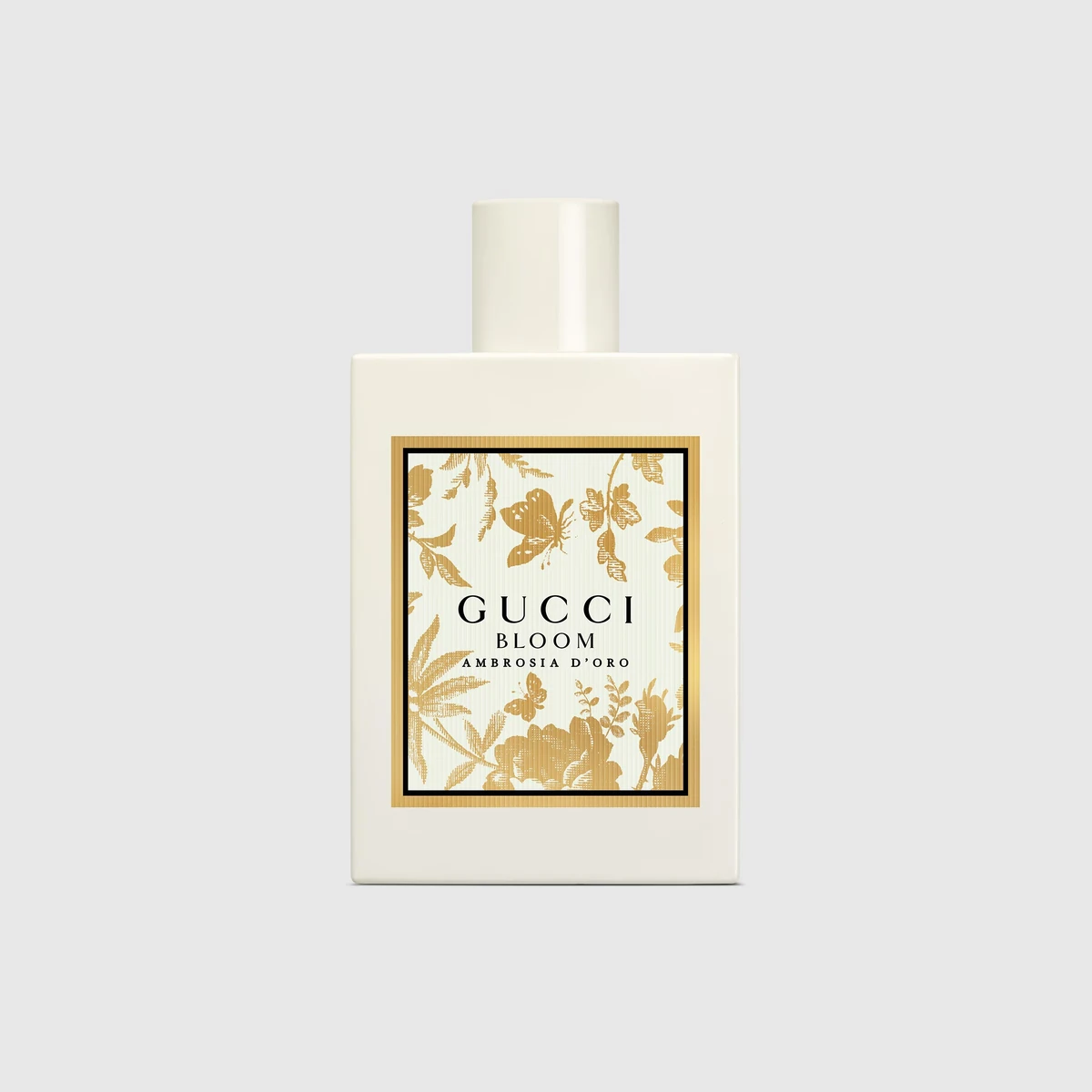
What is Gucci Bloom Ambrosia d’Oro?
The 2026 Ambrosia d’Oro is a Floral Musky Eau de Parfum composed by Alberto Morillas. Gucci lists the 100 ml edition under product style 852697 99999 0099. Contemporary fragrance coverage appeared in February 2026, making this a documented release rather than a product imagined from an old bottle or a new gift set. Gucci's own page describes a reinterpretation of the house's signature white bouquet, with tuberose and jasmine still central.
The exact name matters. Bloom, Bloom Ambrosia di Fiori, Bloom Parfum and Bloom Ambrosia d’Oro are not interchangeable names for a single scent. Listing all of them under a vague title such as “Gucci Bloom gold perfume” may be convenient for a retailer, but it is inadequate for somebody researching the real note list or comparing prices. Confirm the edition, concentration, size and identifying style code before deciding which opinions apply to the bottle.
How does the white-floral identity survive?
The original Gucci Bloom concept is built around jasmine, tuberose and Rangoon creeper. The 2026 edition retains that family resemblance but introduces the language of Golden Queen, ginger, amber-like nuances and musky materials. That means the distinction is not simply “old is floral; new is sweet.” Both are floral, while the surrounding structure and intended texture change. Whether this difference will seem major on your skin remains a sampling question, not a fact settled by advertising.
Official top, heart and base notes of Ambrosia d’Oro
| Tier | Maker-listed examples | How to read them |
|---|---|---|
| Top | Ginger Essence; Ambrox S Super; Golden Globe NaturePrint | Spice and an unusual fruit-inflected lift |
| Heart | Tuberose Absolute; Jasmine Sambac Absolute; Rangoon Creeper NaturePrint; Poison Charmer NaturePrint; Romandolide | Layered floral materials |
| Base | Patchouli Md Essence; Patchouli Prisma II; Sandalwood Spicatum Essence; Cypriol Md Essence | Grounded woody and earthy facets |
This is a selective editorial table; Gucci’s full detailed list includes Jasmine Sambac Closed Buds Absolute and other precise material labels.
Gucci publishes a fairly technical pyramid. Reducing it to three familiar flowers and woods would lose some of the information that makes this release distinctive. Equally, turning every trademarked material into a natural botanical extract would mislead readers. The list below follows the categories shown on the Gucci product page, with an explanation of what those names can and cannot tell us.
Opening: Ginger Essence, Ambrox S Super and Golden Globe NaturePrint
The listed top includes Ginger Essence, Ambrox S Super and Golden Globe NaturePrint. Ginger is associated with a crisp, spicy lift and a freshness that is not identical to lemon or bergamot. Ambrox-type materials can suggest an ambered modern softness, while Golden Globe NaturePrint is presented as part of the fragrance's branded vocabulary. It would be wrong to turn that last term into proof of a specific fruit oil without the manufacturer saying so.
For someone familiar with Bloom's luxuriant floral reputation, this opening creates a useful question: does the new edition present the flowers differently at first contact? That is something to investigate on a blotter and later on skin. The official note order cannot predict the time at which a particular accord appears or guarantee that every user will perceive the ginger as noticeable.
The heart: Tuberose, Jasmine Sambac, Rangoon Creeper and more
Gucci's official heart tier specifies Tuberose Absolute, Jasmine Sambac Absolute, Jasmine Sambac Closed Buds Absolute, Rangoon Creeper NaturePrint, Poison Charmer NaturePrint and Romandolide. This detail is helpful because a casual summary that says merely “jasmine and tuberose” misses several aspects of how the company frames the composition.
Tuberose and jasmine belong to the vocabulary of rich white-flower perfumes, while Rangoon Creeper is part of the historic Bloom identity. But names such as Romandolide and NaturePrint should not be interpreted as six separately bottled flower extracts that appear one after the other. Some represent musky or reconstructed olfactory effects. A perfume is a balanced mixture, and the labeled notes are an explanatory arrangement rather than a complete laboratory formula.
The foundation: patchouli, sandalwood and cypriol
The base notes are Patchouli Md Essence, Patchouli Prisma II, Sandalwood Spicatum Essence and Cypriol Md Essence. Patchouli can bring earthy or woody associations; sandalwood is commonly linked with a creamy, rounded impression; cypriol can evoke a drier woody character. These associations are useful for planning a sample test, but they cannot establish exactly how dark, sweet or powerful this individual formulation smells.
This is especially important in a line whose fans may expect intense white florals. A listed woody base does not make the perfume a predominantly masculine wood scent or imply that flowers disappear quickly. A good comparison involves smelling the new release alongside the original at separate stages, without assuming that the materials always behave in isolation.
What does Golden Queen Accord mean?
Gucci explicitly describes Golden Queen Accord as radiating velvety apricot-like nuances through the white-floral bouquet. The same product description mentions the freshness of Jasmine Hedione. These details are distinctive enough to deserve their own explanation because an online summary might simplistically relabel the entire perfume “apricot and vanilla.” That description would not reflect the manufacturer's structured notes.
An accord is a designed olfactory impression, often achieved by combining multiple materials. An apricot nuance is not proof that natural apricot extract appears as a separate top note, just as an imagined golden glow is not a listed honey note. The name Golden Queen comes from Gucci's prose; Golden Globe NaturePrint is separately named in the official top tier. Keeping the two expressions distinct avoids creating a false extra layer of ingredients.
Does d’Oro mean a gourmand fragrance?
Not necessarily. The Italian expression evokes something golden, but a bottle color and a poetic name do not define the perfume's chemical composition or fragrance family. Gucci's chosen designation is Floral Musky, not a declaration that vanilla, edible sugar or honey must be present. A wearer might describe a creamy or honeyed impression, yet such personal language should be recognized as an impression rather than promoted into an official ingredient claim.
Ambrosia d’Oro vs original Gucci Bloom: what actually changes?
The original Gucci Bloom Eau de Parfum was launched in 2017. Gucci has long described its core around natural tuberose, jasmine and Rangoon creeper, sometimes using the image of an imaginary flourishing garden. Ambrosia d’Oro keeps those white-flower references but spells out ginger, its Golden Queen concept, an extensive heart and a patchouli-sandalwood-cypriol base. That is a genuine difference in the announced architecture.
What the note lists do not establish is a universal winner. If you already love the straightforward garden feeling of original Bloom, a newer iteration may not improve your experience. If you would like to explore the same floral idea with a different opening and a musky-woody frame, Ambrosia d’Oro could be a sensible sample candidate. Blind buying another large Bloom bottle simply because the collection expanded is not an evidence-based recommendation.
Is this Ambrosia di Fiori under a new name?
No. Bloom Ambrosia di Fiori is a distinct earlier release and should not be confused with Ambrosia d’Oro. The names share the word Ambrosia, but the remainder identifies different products. Search engines and second-hand marketplaces sometimes compress both names in titles, so check the full product label and manufacturer image before accepting any user review or seller note as relevant.
The safest comparison remains an exact-edition comparison. Using an account of one flanker to describe another can produce wrong note pyramids, mistaken launch years and misleading expectations. This is also why a single “Gucci Bloom review” page cannot answer every buyer's question about the expanded line.
Bottle, product code and edition identification
Gucci describes a square bottle lacquered in ivory and sealed with an Herbarium motif, accompanied by yellow-gold Toile de Jouy packaging. The official 100 ml listing carries style code 852697 99999 0099. Those details are more reliable for checking whether a product photograph belongs to the intended edition than assumptions based only on a warm-toned color palette.
However, visual similarity alone is not a certification of an individual bottle's authenticity. Counterfeit packaging can mimic familiar cues. Choose a reliable seller, request clear information on the exact edition and keep the invoice and return policy in mind. The correct official promotional photograph is helpful for editorial identification, but it does not remove the need to confirm image usage permission before reproducing that photo on another website.
Who might enjoy Ambrosia d’Oro?
Gucci markets this fragrance for women. As a matter of personal preference, however, nothing about tuberose or patchouli prevents someone of another gender from enjoying the composition. A person who likes white floral bouquets but seeks additional musky and woody detail might find it relevant. Conversely, a wearer who dislikes tuberose, jasmine or patchouli should not assume that the Golden Queen name will make those facets disappear.
Recommendations based solely on season or occasion are less reliable than they seem. Some users associate white flowers with spring and daytime, while others appreciate woody bases in cooler weather. Neither assumption is a scientific rule. If you're considering the perfume for an office, test a modest application in a comparable setting and respect colleagues who may be sensitive to fragrance. If you're choosing it for an evening event, wear the sample beforehand.
Can we predict longevity and sillage?
No specific figure can responsibly be given from the note pyramid or the Eau de Parfum label alone. Personal reviews vary because application, ambient conditions and perception differ. A few enthusiastic reports of all-day wear do not establish a verified average for everyone, and a disappointed user's brief encounter does not prove universal weakness. Note how the perfume performs for your own use rather than treating isolated ratings as laboratory data.
Choosing a size and comparing value
The Gucci product page checked for this article identifies the 100 ml product. Additional sizes may appear across retailers and countries; verify their SKU and availability instead of assuming the same selection exists everywhere. If you have never smelled Ambrosia d’Oro, a verified sample or smaller authorized product can reduce the risk of purchasing a full bottle that turns out too floral, musky or familiar.
If you compare bottle prices, calculate price per milliliter from the actual currency and price at the time of shopping, accounting for shipping and return conditions. You can use ScentMira's perfume price-per-ml calculator for the arithmetic. Buying the lowest-priced large size is not automatically good value if you already own a similar fragrance or won't use the new one often.
How to evaluate the new edition in a store
First, read the full edition name and concentration on the tester rather than relying on the store's family label. Second, apply one sample to a blotter and observe your immediate reaction without forcing yourself to identify every molecule. Third, if fragrance use is appropriate for you, make a restrained skin test. Fourth, let some time pass before forming a judgment about the woody-musky side. Fifth, compare with original Bloom separately, ideally with enough space between applications that your nose doesn't become overwhelmed.
Write down the practical outcome. Did the white-floral character appeal to you? Did the opening feel different from the original? Did the later texture make it worth owning another perfume in the same line? If you can answer those questions, you have better evidence for a purchasing decision than any generic claim that the newest product is the most sophisticated.
Final assessment: a fresh chapter, not an automatic upgrade
Gucci Bloom Ambrosia d’Oro is a genuine 2026 addition with a documented maker, a detailed official note structure and a concept built around Golden Queen's apricot-like floral facets. Its contribution to the Bloom range is best understood as another angle on a recognizable white-flower identity. Describing its differences carefully is more valuable than inventing a skin-test narrative or promising spectacular performance.
Sample it if you are intrigued by the meeting of tuberose, jasmine, ginger and soft woody-musky framing. If you already enjoy the original, test both before committing to another full-size bottle. Read the product name exactly, don't merge the edition with Ambrosia di Fiori, and remember that a manufacturer's pyramid guides expectations without replacing your personal sense of smell.
Frequently asked questions
Was Bloom Ambrosia d’Oro released in 2026?
Yes. It appeared in dated February 2026 launch coverage and is sold as a distinct new Gucci Bloom edition.
Is it an Eau de Parfum?
Yes, Gucci lists it as an Eau de Parfum; the checked official page is for a 100 ml bottle.
Who created the fragrance?
Master perfumer Alberto Morillas, according to Gucci's product listing.
Does Golden Queen mean there is real apricot extract?
No such conclusion follows. Gucci describes an apricot-like nuance within an accord, not a standalone apricot ingredient in its labeled pyramid.
Is it the same as Ambrosia di Fiori?
No, they are separate Bloom releases. Verify the complete edition names before reading reviews or buying.
What flowers appear in the official heart?
Tuberose and Jasmine Sambac are listed alongside Rangoon Creeper and other specialty olfactory materials.
Are vanilla and honey official notes?
Neither is presented as a separate note in the official pyramid reviewed for this edition.
How long does it last?
There is no universally reliable duration established by its product label or note list. Evaluate a sample in your own conditions.