Some rose fragrances announce their intentions immediately: petals, sweetness, and a romantic atmosphere. Nishane Thorns Become Roses Extrait de Parfum takes a different route on paper. Lychee and raspberry give its opening a bright fruit vocabulary, saffron introduces tension, and a floral heart meets a woody amber foundation. Its title suggests that something initially sharp can become beautiful, but the scent still deserves assessment on its own terms rather than through its poetic packaging alone.
Released in 2026 as part of the Turkish house's Rumi Collection, the fragrance is especially interesting because the brand's structured note pyramid does not exactly match the pyramids repeated by several familiar perfume databases. That distinction matters when someone is considering a blind purchase, checking for a potentially unwelcome note, or simply trying to understand what the company actually claims. This guide provides verified product information, editorial interpretation of the note structure, and practical selection advice. It does not pretend to be an independent skin test or laboratory measurement.
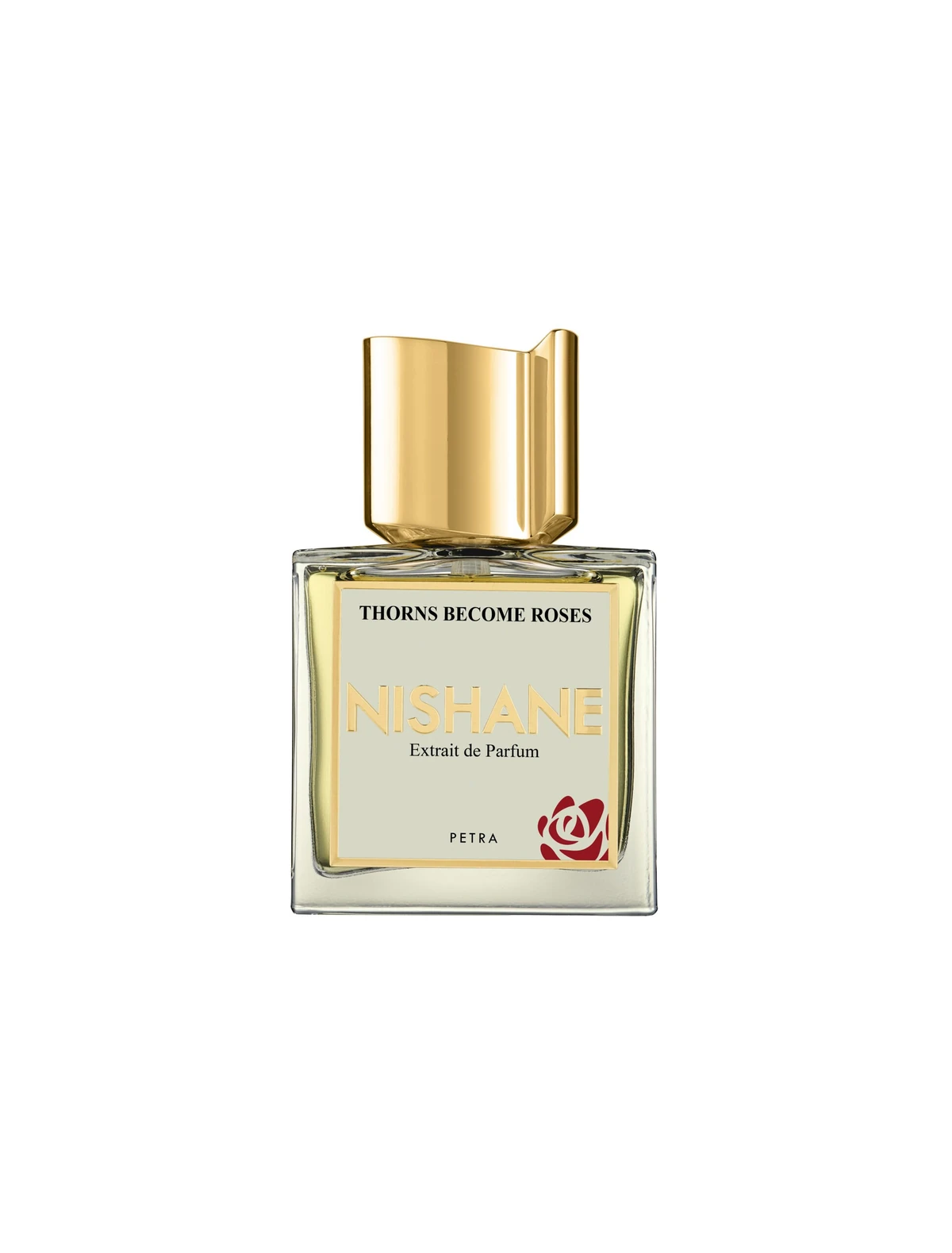
In brief: Nishane Thorns Become Roses is a Rumi Collection Extrait de Parfum. Nishane labels lychee, raspberry and saffron as top notes; rose, mimosa and blackcurrant as heart notes; and patchouli, amberwood and aetoxylon as base notes. Its descriptive copy separately invokes cardamom, violet leaf and sandalwood. Those materials must not be silently added to the labeled pyramid.
What exactly is Thorns Become Roses?
Nishane unveiled Thorns Become Roses in Milan in June 2026, with launch reporting describing wider availability in July. It belongs to the Rumi Collection, whose creative framework draws on the poet Jalal al-Din Rumi, and is marketed as an Extrait de Parfum. Perfumer Julien Rasquinet is credited with creating it. These identifiers are worth recording together: the house, exact name, concentration, and 2026 release year distinguish a real edition from sample listings, bottle-size variations, or unrelated rose perfumes in the same general market.
The house calls its fragrance family fruity, ambery and woody. That is not a contradiction of its rose-led story. Fragrance families summarize a whole structure rather than listing every possible floral ingredient. In this case the fruits frame the beginning, rose anchors the central idea, and woody amber materials supply contrast underneath. What the framework cannot tell you is whether you personally will experience the opening as sweet, whether the woods will dominate, or how quickly the stages will become apparent.
The official note pyramid, without adding imagined ingredients
| Position | Listed notes | Interpretation |
|---|---|---|
| Top | Lychee, raspberry, saffron | Bright fruit with a spicy counterpoint |
| Heart | Rose, mimosa, blackcurrant | Floral texture with dark fruit |
| Base | Patchouli, amberwood, aetoxylon | Woody amber finish |
The narrative on the same page mentions other facets; this table reports the brand’s labeled layers, not an INCI ingredients list or a skin test.
On its product page, Nishane organizes Thorns Become Roses into three tiers. We reproduce that hierarchy as a factual reference, rather than blending it with other sites' versions and calling the result official. Notes are an explanation of a perfume's intended smell; they are not necessarily a chemical ingredient disclosure or a guarantee that every wearer will identify each impression.
Top: lychee, raspberry, saffron
The first tier brings together two fruits and a spice. Lychee can evoke a watery, almost translucent fruitiness; raspberry may suggest a more familiar red-fruit tang or sweetness. Saffron, meanwhile, is a useful counterweight to an entirely playful opening. As a conceptual trio, they create room for both brightness and edge. It would be inaccurate to insist that saffron is loudest or that raspberry lasts a particular number of minutes, because those details are not given by the note list itself.
This is also a good test of preferences. If you like rose perfumes with fruit in the opening, the combination is promising enough to sample. If your experience with saffron-heavy fragrances has been unpleasant, do not assume the fruit will neutralize that concern. A short blotter test followed by a careful skin trial can clarify the issue much better than a list of names.
Heart: rose, mimosa, blackcurrant
Rose is the conceptual center, while mimosa adds an association with soft, pollen-like or powdery floral effects. Blackcurrant is particularly noteworthy: Nishane places it in the heart tier, not in the top tier, and several third-party pyramids omit it. Its presence suggests the brand wants a thread of fruit to remain relevant after the opening. That is an interpretation of the arrangement, not a claim that a literal blackcurrant aroma always becomes stronger on the skin.
The brand's descriptive text refers more specifically to Turkish rose, while the labeled pyramid uses the broader term rose. Both details can be retained accurately by identifying which part of the official presentation they come from. Neither establishes the amount of natural rose absolute in the formula, and neither makes the fragrance objectively more masculine, feminine, refined, or expensive than any comparable composition.
Base: patchouli, amberwood, aetoxylon
Patchouli and amberwood are familiar to many niche fragrance readers. Depending on formulation, the first can lend earthy or dark woody character, while the latter belongs to a modern amber-wood style. Nishane's third listed base note is aetoxylon. It is tempting to replace that unfamiliar name with sandalwood because the brand discusses sandalwood in its promotional prose, but that would erase a meaningful distinction between two parts of the company's material.
The base does not prove that this will smell like smoke, oud, wet earth or clean laundry. Those descriptors are possibilities people might associate with some woody notes, not confirmed sensory outcomes for this particular fragrance. The responsible way to evaluate the drydown is to experience it and check back over time. Treat a formal note list as a map of intentions, not a stopwatch or a laboratory formula.
Why do some perfume directories list different notes?
The discrepancy is visible and important. Nishane's labeled top tier is lychee, raspberry and saffron; its heart is rose, mimosa and blackcurrant; its base is patchouli, amberwood and aetoxylon. On the same brand page, however, the descriptive paragraphs also invoke cardamom, violet leaf, Turkish rose and creamy sandalwood. Third-party databases often turn several of those descriptive facets into additional formal note entries.
As a result, a reader may see cardamom at the top, violet leaf in the middle and sandalwood at the bottom of a database chart, while blackcurrant or aetoxylon is missing. One cannot fix this discrepancy by silently making a longer, combined pyramid. That would create a new list whose authorship is unclear. Instead, distinguish three information levels: the structured house pyramid; extra facets in the house's descriptive text; and independently edited database classifications.
There may be editorial, marketing or categorization reasons for the different presentations, but their precise cause has not been publicly demonstrated here. A note is not always a single natural extract, either: a perceived accord can arise from multiple raw materials. If you are avoiding a specific fragrance family or molecule for personal reasons, a marketing pyramid is not an adequate technical disclosure. Contact the seller or manufacturer for appropriate ingredient and safety information where needed.
Where does the Rumi story enter the composition?
The name transforms thorns into roses. Within the Rumi Collection, that works as an image of change: roughness moving toward tenderness, friction turning into warmth. It gives Nishane a narrative frame for a perfume that combines contrasts rather than presenting one continuous smooth floral note. The saffron-fruit opening, rose-centered heart and deeper woody amber foundation can be read as three different chapters of that frame.
Yet it is worth keeping creative metaphor separate from fragrance science. The poet's imagery cannot determine whether a rose smells dark or luminous to every wearer, and marketing language cannot tell you how many hours the perfume will last. It can explain why the house chose this particular design language, while your nose determines whether that design works for you. Appreciating the story and declining to buy the fragrance are perfectly compatible responses.
Is this just another straightforward rose perfume?
Not according to the brand's architecture. A straightforward soliflore might attempt to foreground one identifiable flower, whereas this release intentionally places rose amid fruit, saffron, patchouli and amberwood. That makes the concept more layered. Whether its actual smell is original compared with the wider niche rose market requires controlled comparative smelling; neither an ingredient list nor a promotional story can establish superiority over another product.
Is Thorns Become Roses for women or men?
It is presented as a fragrance for women and men. Rose should not be treated as intrinsically feminine, just as dense woods should not be assumed masculine. Your comfort with a spicy floral-woody combination matters far more than a shelf label. If you generally enjoy flowers but dislike strong dry woody structures, sample this one carefully. If your collection emphasizes amber and wood and you are curious about bringing rose to the forefront, it may be worth exploring.
These are preference-based suggestions, not tested demographic conclusions. There is no reason to claim everyone who wears the scent will perceive its fruity facet, and there is no evidence here to assign a gender percentage. The fragrance does not require the user to fit a predefined personality; it simply gives people with different tastes several features to investigate.
Office wear, evenings and warm weather
Do not assume that Extrait de Parfum automatically makes this a night-only scent or guarantees exceptional projection. Concentration labeling alone cannot answer those questions. In shared spaces, a modest application and a test on a normal working day are sensible. For an event, try the perfume before the date rather than applying it at full strength for the first time just before arriving. Temperature, ventilation, dose and personal perception all affect how a scent is experienced.
15 ml, 50 ml or 100 ml: choosing your size
The brand lists 15, 50 and 100 ml options on its product page. That does not mean there are three different compositions. They are different quantities of the same named Extrait de Parfum unless a retailer clearly states otherwise. Third-party stores may offer additional travel formats; do not assume those are available on the manufacturer page without checking the exact listing.
The smallest official size can be an attractive route for repeated personal testing. A 50 ml bottle may offer a middle ground for someone already confident in the perfume, while 100 ml makes more sense after you know that it will become part of your routine. Cost per milliliter helps compare offers, but the lowest unit price is not necessarily the best purchase if the smell is untested or the bottle will sit unused. ScentMira's perfume price-per-ml calculator can help you calculate the arithmetic using actual shop prices, without pretending to track live retailers.
A practical five-step sample test
First, confirm the edition name and Extrait de Parfum concentration on the vial. Second, smell the fragrance from a blotter without forcing an immediate verdict. Third, if it is safe for you to wear fragrance, test a modest amount on skin and avoid comparing it with several heavily sprayed competitors at once. Fourth, note how your perception changes later, rather than inventing a universal progression in minutes. Finally, return to the official top, heart and base list to identify where your observation agrees or differs.
If you dislike the opening but enjoy the later character, this is useful information; if you enjoy the first few seconds but not the drydown, it is equally useful. Avoid ranking the fragrance by an unsupported number of hours or by a reviewer's dramatic description alone. A good purchase decision combines verified facts with your own relevant experience.
Verdict: who should put it on a sampling list?
Nishane Thorns Become Roses deserves consideration from people intrigued by rose, fruit, saffron and contemporary woody amber in a single 2026 composition. Its genuine point of editorial interest is not an invented claim that it defeats every rose fragrance on the market; it is the deliberate use of contrast and the fact that the official note pyramid warrants careful reading. The Rumi concept adds narrative context, but it should remain secondary to how the perfume actually smells to you.
Start with the exact edition, compare the house's labeled list with its descriptive prose, and try the smallest sensible format before a large purchase. If a note discrepancy matters to you, seek clarification rather than trusting a compiled chart as a formula disclosure. There is enough to be curious about here without claiming first-hand wear results that have not been obtained.
Frequently asked questions
Did Nishane release Thorns Become Roses in 2026?
Yes. The perfume was unveiled in June 2026, with a wider July launch reported by contemporary coverage.
What concentration is it?
It is sold as an Extrait de Parfum; that label does not independently establish specific longevity or projection figures.
Who created it?
Perfumer Julien Rasquinet is credited with its creation in contemporary launch sources.
Is there cardamom in the top notes?
Cardamom appears in the brand's descriptive text and some database pyramids, but not in the top-tier list labeled on Nishane's product page.
What does Nishane list in the base?
Patchouli, amberwood and aetoxylon. The brand also discusses sandalwood descriptively, which is not the same as listing it in that base tier.
Which bottle sizes are official?
At the time of research, the brand product page listed 15, 50 and 100 ml options.
Is it unisex?
Yes, it is marketed for women and men, but individual preferences rather than gender determine how appealing it may be.