A special release for the Gulf in 2026
Oud Zuhal is a 2026 limited-edition fragrance from Oman's Amouage, launched for the Ramadan season within The Essences collection. Contemporary launch coverage identifies the GCC as its original sales region, giving the perfume a distinctive distribution story. That fact is important when comparing official boutiques, reseller offers and reviews written elsewhere in the world. A fragrance appearing at a foreign reseller does not change its original regional launch or automatically establish that every listed bottle is genuine.
The Arabic word Zuhal refers to Saturn, providing the creative association with time and distance. Amouage builds this interpretation around oud and an elaborate infusion process rather than a conventional citrus-and-floral story. The name is not proof of a supernatural effect, nor can the symbolism tell us how the liquid performs. This editorial guide focuses on the edition, its published olfactory structure and cautious buying advice without inventing personal wear experiences.
An Essence, not an ordinary eau de parfum label
Amouage calls the product an Essence, placing it within a collection that explores unusual approaches to perfume construction and ageing. Reports about the release refer to approximately 30 percent fragrant concentrate. That number belongs to the product's positioning and should not be rewritten as a guaranteed longevity figure. When cataloguing the perfume, the exact commercial identity matters: Oud Zuhal Essence 2026 rather than a guessed Eau de Parfum concentration or a different Amouage oud.
Other members of The Essences collection do not become alternative sizes of Oud Zuhal merely because they share a design family. Separate exact names, years and product concentrations before counting subjects in a fragrance library. The correctly labelled bottle is a useful visual clue, but the substance of the guide lies in distinguishing this GCC edition from unrelated historical releases and future packaging variations.
The spicy top of black pepper, pink pepper and cardamom
Contemporary reports present black pepper, pink pepper and cardamom as the opening notes. These materials suggest a spicy introduction, but a list does not determine whether the first impression will feel dry, warm, lively or balanced on every person. Pink pepper does not necessarily smell the same as kitchen black pepper, and cardamom can be associated with different cultural memories depending on the wearer.
If cardamom reminds you of Gulf coffee, that association can be pleasant, yet the official list does not identify coffee as a note. It is more accurate to consider the opening a spice framework leading toward oud. A trial should ask how the spices interact with the fragrance as they settle. No timing chart or precise dominance order can be derived from three names printed on a pyramid.
Assam oud and patchouli at the heart
The heart combines Assam oud and patchouli in the published launch information. This is a meaningful distinction from an article that simply says oud and assumes all oud references are identical. Geographic descriptions give context to the marketing story, but they do not disclose the proportions of any natural raw material in a finished composition. Patchouli contributes another earth-and-wood reference in a scent positioned as woody, ambery and balsamic.
Give the fragrance time after its opening spices before deciding whether you like the center. You may respond to the overall contrast rather than recognising a neat sequence of isolated materials. Oud enthusiasts might reasonably put this edition on their sample list, but a prestigious house name is not evidence of universal appeal. Nor can performance or raw-material concentration be inferred from the presence of an Assam oud note alone.
The amber base and the infusion patina
Some fragrance databases place Indonesian oud directly within the base, alongside amber. However, the detailed release presentation separates the principal base note of amber from an infusion-patina layer involving Indonesian oud and oakwood. That separation matters because a structured note pyramid and an account of how materials are used during production do not describe exactly the same thing. Combining every mention into a single level can misrepresent the maker's concept.
Amber itself is an olfactory term that may represent an accord, not a certification of natural animal ambergris. Similarly, mentioning Indonesian oud in the infusion does not tell us a precise quantity, species certificate or the production steps behind every bottle. The clearest summary is a spiced opening, an Assam oud and patchouli heart, an amber base and separately described Indonesian oud and oakwood infusion elements.
Why Amouage discusses double infusion
The Essences project explores what Amouage calls a double-infusion process. Earlier examples used sandalwood, while Oud Zuhal places oud chips at the center of the technique. Creative director Renaud Salmon describes the change as adding depth to the fragrance's character. Specialist coverage mentions 42 days for the perfume concentrate and six weeks for a bioethanol-related stage. These are manufacturing intervals, not estimates of how long a spray lasts after application.
It is tempting to treat any longer processing time as proof that a fragrance will wear longer than a competing one. That conclusion does not follow. Ageing, infusion, longevity and projection are distinct concepts. We can acknowledge the craftsmanship described by the brand without converting it into an unverified scientific comparison. The most useful question for the buyer remains whether the resulting composition feels desirable to wear.
Limited GCC availability and the original dates
Reports describe availability on the Amouage website and in Omani boutiques starting February 23, 2026, followed by selected GCC stores and approved retail partners from February 25. These dates verify that Oud Zuhal is a real 2026 launch rather than an announcement awaiting an unspecified future release. They do not guarantee today's stock or the accuracy of an unrelated online reseller's listing.
Regional exclusivity is a statement about the intended initial distribution, not a universal rule that any later international listing must be counterfeit. Still, it makes careful verification particularly valuable. Check the seller's business, return conditions, product photographs and exact edition when facing substantial prices. A credible supply chain is as important as the poetic story of an exclusive scent.
The exact bottle, captured from the maker
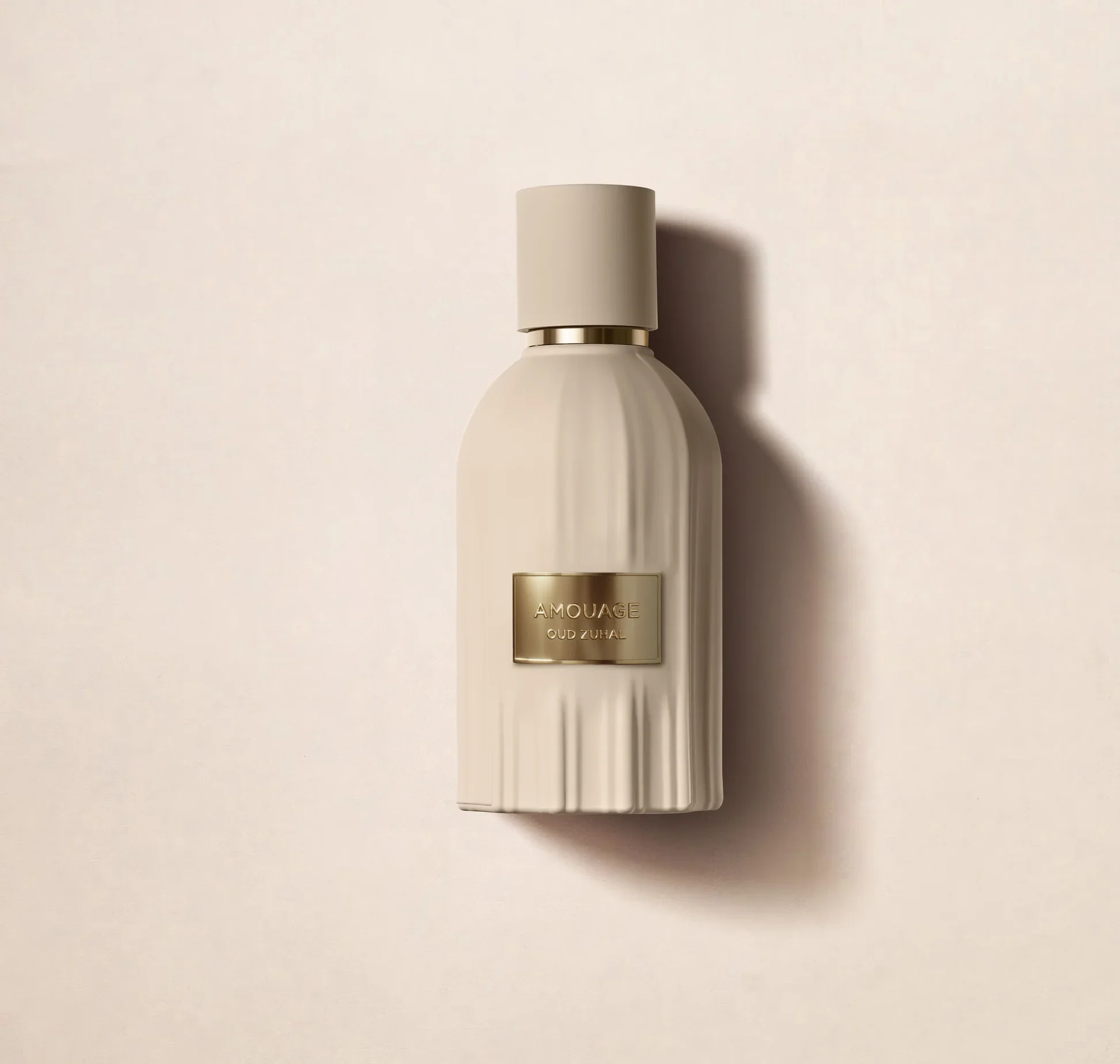
The accompanying image is a WebP copy of the Amouage-hosted Oud Zuhal product photograph. It shows the light, sculpted bottle with a gold nameplate bearing AMOUAGE and OUD ZUHAL. The image is held in ScentMira's own static assets rather than fetched by the reader's browser from a third-party host. This establishes a precise photo-to-edition match, although independently documented commercial redistribution rights have not been confirmed.
A seller's generic cream-coloured bottle photograph is not enough to prove identity if the nameplate is unreadable. Cross-check the exact product name and presentation, particularly within The Essences series. Image matching assists recognition but does not itself authenticate a reseller. Nor is a campaign photograph evidence of the contents of an unknown physical bottle offered on a marketplace.
Seasonal associations without rigid rules
Oud Zuhal was introduced for Ramadan and originally aimed at the Gulf, so buyers may naturally associate it with festive evenings, traditional oud preferences and regional fragrance culture. Those associations make sense as context but do not impose a rule that the scent belongs exclusively to evenings or to any particular gender. The same spicy and woody composition can appeal in different routines.
Consider your surroundings when sampling, especially offices and shared enclosed spaces. Begin with a restrained amount, observe the development and check your comfort with the spice-to-oud transition. A high fragrance concentration does not tell you in advance how many sprays are appropriate for all situations. Individual sensitivity and proximity to others remain important.
Longevity, projection and what remains untested
The 30 percent concentration and weeks-long production description may encourage expectations of exceptional performance. Nevertheless, we have not independently measured how many hours Oud Zuhal remains detectable or how far it projects. Skin, fabric, temperature, amount sprayed and olfactory adaptation change the experience. No responsible edition guide should present a numerical performance score as a fact without a defined test.
A useful personal evaluation separates persistence close to your skin from sillage around you. Try the fragrance in a normal setting and revisit the scent after the opening and later in the day. If you do not notice it constantly, consider that olfactory adaptation can affect perception. A single anonymous review cannot guarantee the outcome for your skin, and a costly release is not automatically a stronger one.
Launch price references need local context
Specialist coverage listed original suggested prices for the 100 ml edition across selected GCC markets: 200 Omani rials, 2,250 UAE dirhams, 230 Bahraini dinars and 185 Kuwaiti dinars. Those historical launch figures are not today's inventory quotations, and they should not be presented as a fixed Saudi price. Resale channels and location can create substantial differences in cost and delivery conditions.
If shopping online, compare a verified offer for the exact same size and identity, including shipping, taxes and return policy. Currency conversion alone can conceal added costs, especially for a limited regional fragrance. Check authenticity and provenance before considering whether a small discount is worthwhile. The goal is a sound purchase, not an impression of prestige based only on a large number.
A considered verdict for Oud Zuhal 2026
The most compelling reasons to sample Oud Zuhal are its distinct 2026 Gulf launch, the black-and-pink-pepper and cardamom opening, its Assam oud and patchouli center, and the separately described Indonesian oud infusion. These facts distinguish it from many generic oud listings. They do not by themselves prove it is the finest oud perfume, the longest wearing Amouage or a guaranteed match for every collector.
Try it with attention to the progression and your actual preferences. If you enjoy the spices but find the heart too intense, there is no reason to purchase simply because the edition is limited. If the complete structure appeals to you, confirm the bottle and seller before making a costly purchase. Well-grounded research helps narrow the choices; firsthand experience remains essential.
Frequently asked questions
When was Amouage Oud Zuhal released?
It was introduced in February 2026 as a limited-edition GCC-focused release within The Essences collection.
What are its announced notes?
Top: black pepper, pink pepper and cardamom. Heart: patchouli and Assam oud. Base: amber, with Indonesian oud and oakwood separately described as infusion-patina materials.
Is it an eau de parfum?
The house positions it as an Essence and launch reporting describes roughly 30 percent perfume concentrate.
Does 42 days of ageing mean 42 days of wear?
No. Production and maturation periods describe manufacture, not fragrance persistence on skin.
Is the bottle photo exact?
The local WebP derives from the maker's Oud Zuhal packshot with its corresponding nameplate; reuse rights are not independently verified.
Can everyone buy it globally?
Its original limited release targeted GCC markets, and current third-party inventory requires separate verification.