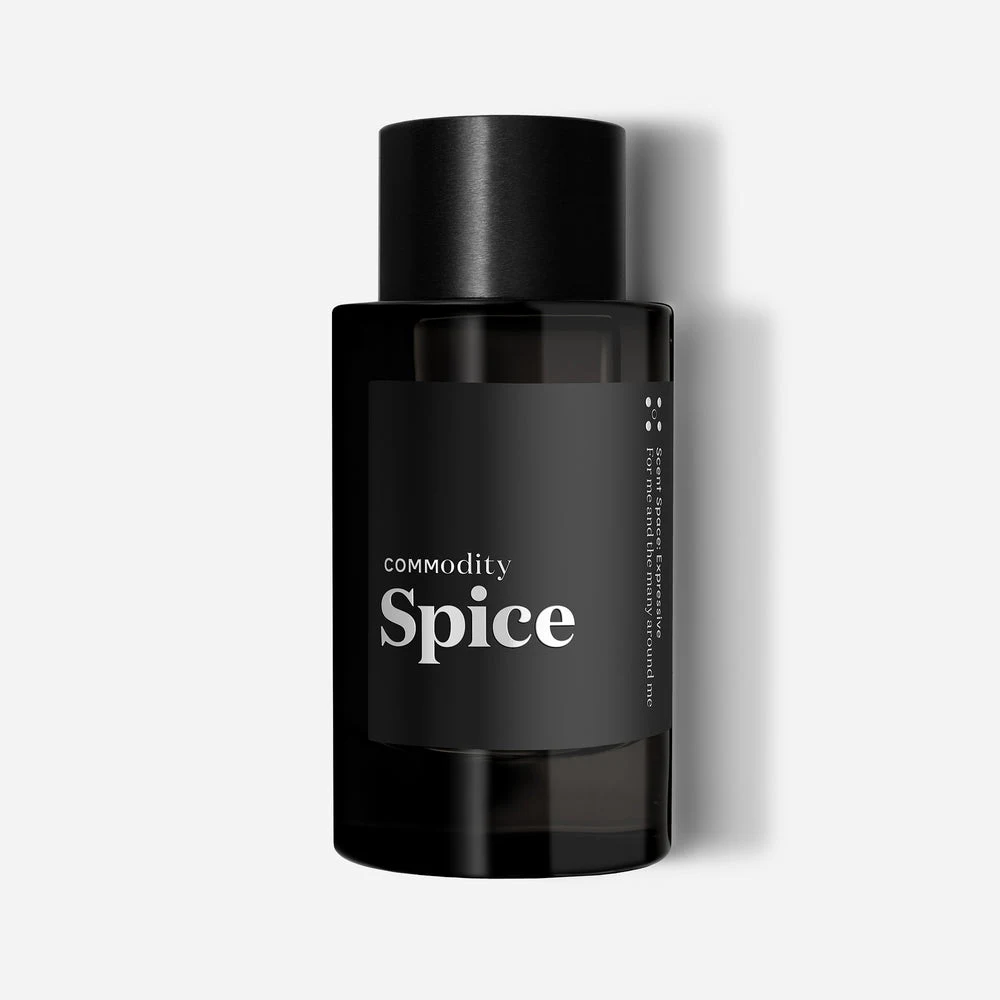
A new Spice, with a precise identity
Commodity Spice Expressive Eau de Parfum belongs to the Spice trio launched on 6 October 2026. If you are looking for the middle Scent Space, this is the bottle simply labelled Spice, without a plus or minus sign. That small distinction matters: Personal and Bold are different interpretations, rather than interchangeable names for the same liquid in different sizes.
The useful question is whether a sweet, aromatic spice composition fits your wardrobe. This guide draws on the manufacturer's product description and development account; it is an editorial interpretation, not a report of our own skin test. Think of it as a way to identify what you should smell for when you encounter a sample, particularly if saffron is an ingredient you sometimes find challenging.
Why the chai reference matters
The official story connects perfumer Christelle Laprade's work to the ritual of preparing chai. That points towards the balance of aromatic spice and creamy sweetness, rather than a conventional bright citrus fragrance. Saffron, allspice and cinnamon sugar form the recognisable theme. A chai association describes the overall idea; it does not establish that tea leaves are an officially listed note in this edition.
That distinction can prevent a disappointing purchase. Someone seeking the dry bitterness of black tea may be evaluating the wrong aspect, while a person drawn to the smell of warmed spices and a milky backdrop has a more relevant starting point. Our reading of the composition is that its interest lies in texture: the tension between a slightly suede-like spice impression and the comfort suggested by the gourmand elements.
Reading the official development
For Expressive, Commodity presents saffron and allspice first, cinnamon sugar and condensed milk next, and tonka bean with sandalwood finally. These are the published stages of the fragrance description. They should not be treated as a laboratory timetable: there is no promise that one note disappears at a fixed minute or that every wearer will recognise each material separately.
Allspice is also worth reading carefully. Its name does not mean an unspecified mixture of every cooking spice. When the brand evokes clove, cardamom or nutmeg facets around that note, those comparisons help explain an aromatic impression. They are not a reason to expand the official pyramid with a list of independently verified essential oils. Similarly, condensed milk is a scent note, not proof of dairy ingredients in the bottle.
Expressive, Personal or Bold?
Expressive is the reference point of Commodity's Scent Space system. Personal turns the idea inward with Helvetolide and Ambroxan, while Bold moves towards a deeper leathery expression with Safraleine. These differences make a side-by-side sample useful. If the core saffron impression bothers you, simply choosing a smaller bottle of Expressive will not change that central character; trying the other formulation might change the balance you perceive.
The brand displays Expressive at 20% concentration and Personal at 22%. This is a helpful reminder that concentration percentage and perceived reach are different questions. A higher number does not automatically mean a louder fragrance. Consider how the whole formula behaves near you, at conversation distance, and after some time, rather than ranking the three versions purely by percentage or assuming their names promise a particular number of hours.
Who should put it on a sampling list?
Spice Expressive is a plausible candidate for someone who enjoys gourmand fragrances but wants aromatic tension alongside sweetness. The published profile gives you specific things to investigate: whether the saffron reads pleasantly textured, whether the cinnamon sugar feels balanced, and whether the later woody impression keeps the sweetness comfortable. The house presents it as genderless; personal taste is a more useful filter than the men's or women's shelf.
It deserves extra caution if your favourite perfumes are airy, sharply green or almost unsweetened. Equally, a love of vanilla desserts does not automatically predict a love of saffron. Before committing, describe your preferences in contrasts: creamy versus dry, smooth versus leathery, spicy versus sugary. Then use the sample to decide which side dominates for you. That produces a clearer buying decision than asking whether the fragrance is universally pleasant.
Choosing an occasion without inventing performance
Its warm gourmand theme makes cooler evenings an intuitive occasion to explore, but that is a styling suggestion, not a restriction. In a warm climate, an air-conditioned evening and an outdoor afternoon are very different settings. Try the fragrance in the environment where you intend to wear it, and judge whether the sweet spice character still feels comfortable after the first impression has passed.
For shared offices or close seating, begin conservatively and assess the space around you. We do not assign a fixed longevity score or promise a particular trail: no controlled wear test was performed for this guide. A fragrance can remain detectable close to skin without being obvious across a room. If performance determines your purchase, compare those two observations separately instead of treating any lingering trace as evidence of strong projection.
A sample test that answers the right questions
First confirm that your sample is Expressive, rather than Spice+ or Spice-. Test it on clean skin without another scented product nearby, then return to it later instead of repeatedly smelling the same spot. Record a few practical observations: initial spice character, sweetness after settling, comfort at conversational distance, and whether you still want to wear it at the end of your normal activity.
On another day, try the closest alternative with a similar amount and in a similar setting. Avoid drawing conclusions from a crowded shop where several perfumes overlap. If you can compare a blotter with skin, keep the two observations separate. The paper can help identify the general direction, while the skin trial answers the more personal question of whether that direction suits you during real use.
Buying the exact edition and judging value
Check that the listing names Commodity Spice Expressive Eau de Parfum and that the bottle has the plain Spice identity. The product photograph accompanying this guide shows the black Expressive bottle, sourced from the matching manufacturer's page. A shared family name or a familiar black bottle is not enough to establish that a seller is offering the precise Scent Space you sampled.
Compare total cost against usable volume and how frequently you expect to reach for it. A travel size may be a sensible first purchase when you are uncertain about saffron, even if its price per millilitre is higher. For a bottle you already know you will finish, the calculation can favour a larger size. Shipping, taxes and the seller's return conditions belong in that decision; we do not present a fixed worldwide price or an unverified authenticity guarantee.
Frequently asked questions
Is Spice Expressive a 2026 release?
Yes. Commodity's dated development account announces the Spice Scent Space trilogy for 6 October 2026. Expressive is its central interpretation, distinct from Personal and Bold.
Does it actually contain chai tea?
Chai is the creative reference. The Expressive description lists saffron, allspice, cinnamon sugar, condensed milk, tonka bean and sandalwood; it does not identify tea leaves as a separate featured note.
Is Expressive stronger than Personal?
The names describe intended Scent Space. Formula balance affects perceived reach, so the displayed 20% and 22% figures cannot establish a universal strength ranking or fixed wear time.
Is this a hands-on review?
No. This is a source-based editorial guide with practical sampling advice. It does not claim personal wear testing, measured longevity, or a guaranteed result on your skin.